
Quantum sensing – explainer and overview
The technology is close to commercial viability, but is still constrained by the laws of physics
What is quantum sensing?
Quantum sensing is an area of quantum technology that gets a lot less attention than quantum computing. However, not only does it have a lot of potential, it’s also probably much closer to being actually useful than quantum computing.
Quantum sensing is a catch-all term that refers to a diverse range of technologies – however in general they involve relying on how quantum phenomena are influenced by changes in their environment (eg in gravitational, electrical or magnetic fields) and/or use of quantum “superposition” (wave-like behaviour) for measurements. The fact that quantum systems are very fragile and susceptible to very small environmental changes is a big headaches for quantum computing, but is the reason why quantum sensing works at all.
What’s the point of a quantum sensor?
There are existing conventional, or classical, sensors that are currently used for the applications quantum sensors are proposed for. The potential advantages of using a quantum sensor vary – in some cases they offer an opportunity to save on size, weight and power (SWaP). Such an example is radio frequency sensors, where classical sensors need an antenna which is similar in size to the wavelength of the signal being detected, which can be several metres or more at lower frequencies. A quantum sensor, on the other hand, doesn’t have such a constraint, so the overall radio receiver can be much smaller. Another advantage can be that the response of quantum sensors depends on fundamental physics, so there is no need to calibrate each sensor, and they don’t drift over time. Another advantage they may provide is better sensitivity, ie they can detect much smaller changes in the relevant environmental variable than a classical sensor.
What are the limitations of quantum sensors?
While quantum sensing has significant potential, it’s not some miracle technology that will make everything visible to everyone. For example, some have speculated that they will make the ocean transparent and submarines irrelevant. Significant advances in sensors and using AI to processing the data from are likely in coming years, but it would be a big stretch to claim they could reliably detect submarines that remain well below the surface.
Although the underlying science may predict quantum sensors can achieve very high levels of sensitivity, practical systems are going to be potentially many orders of magnitude worse than this predicated theoretical limit. This is due to the fact the sensor needs to be integrated with other (non-quantum) equipment to provide a working system, and that will introduce additional noise.
Quantum sensors are also potentially constrained by other noise in the environment they are sensing. An example I often use is to imagine you are in a busy multi-storey office building, and have a microphone guaranteed to pick up anyone talking anywhere in the building. However, unless you are using it late at night, you are very unlikely to hear someone in a far away office, because at any one time it’s likely many other people are talking as well.
Interestingly, one of the trade-offs that quantum sensor often make is they can be very sensitive so small changes within a limited range of values. Therefore you often see a classical sensor paired with a quantum one – the classical one does a rough measurement which can be used to set up the quantum one to get a more exact measurement in the correct range.
How mature is the technology?
As noted in the introduction above, quantum sensing is one of the more mature areas of quantum technology, especially compared to quantum computing and communication. However, this doesn’t mean it is yet ready for mass market commercial deployment.
In particular, there is often a big gap between having something working on a bench in the lab and being able to package it up for real-life use. Generally the use cases for quantum sensors require being able to transport them easily, potentially on aircraft or the back of a truck. They also may need to be deployed into harsh environments – maybe prospecting for minerals in remote areas and extreme temperatures. This represents an additional set of engineering challenges, and in particular this might erode some of the advantages, such as the sensitivity when the sensor is connected up to other systems to stabilise it.
Systems such as gravitational sensors, which could potentially be used to detect groundwater or mineral deposits underground are at a field trial stage with companies such as Nomad Atomics. Radio frequency sensors are generally at an earlier stage, with interesting results being proven in the lab but not yet able to be tested outside a lab environment.
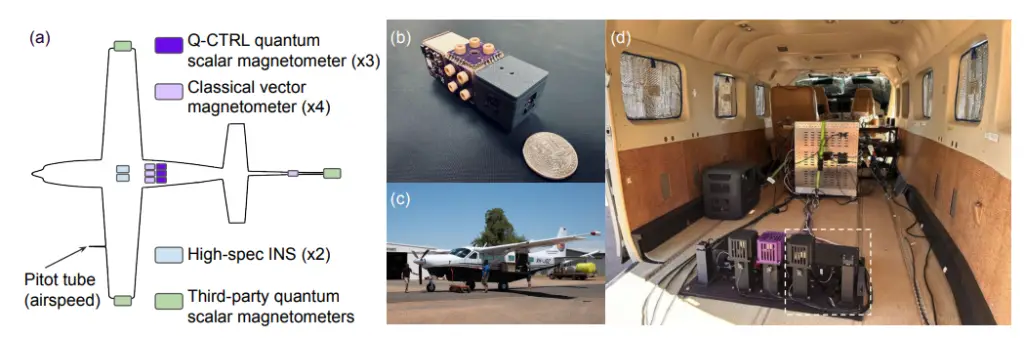
There are examples that are closer to commercial viability. For example, Q-CTRL have demonstrated the use of a quantum magnetic sensor onboard an aircraft for navigation – see the case study below for more details.
CASE STUDY – Quantum magnetic sensors for navigation
An important use case is finding ways to provide accurate navigation without relying on GPS – because many systems rely on GPS today, but we know GPS can be easily jammed or spoofed. A common solution is an inertial navigation system (INS) that detects movement and acceleration to work out how far an object has moved and in what direction from a known starting point. The problem is these systems are mechanical, based on weights and spring, that require regular calibration, and even then can accumulate errors over long periods of operation.
Q-CTRL’s Ironstone Opal solution used a quantum magnetic sensor to detect small changes in the Earth’s magnetic field and compare this to a known reference map of the Earth’s magnetic field. In this way it could regularly correct the position calculated by the INS, so ensuring errors did not build up over time. As an example of the value range problem noted above, it actually needed to be deployed with a conventional magnetometer as well.
The system was trialled on an aircraft, where the output of the combined INS and quantum sensor system could be compared to the INS alone, and the accuracy of both calculated by comparison to the known true trajectory measured using GPS. For one test flight of around 750km at 19,000 feet altitude, the positional error from the INS grew steadily over time to be over 60km by the end. In contrast the Ironstone Opal error was mostly 5km or less throughout the entire flight.
However, showing some of the limitations, there were some times when the error was over 10km and it even went up to 20km for a period of time. This was probably where the Earth’s magnetic doesn’t vary enough for the magnetic sensor to give a good location fix. Also, it was seen that the INS errors grow fairly steadily over time, whereas the quantum system errors fluctuate up and down but are fairly similar throughout the flight – so in the early stages the INS actually does better. This only appears to be for the first 10-15km, however, so most flights of useful length could potentially benefit from the quantum system.
The system has subsequently also been proven on board an Australian Navy ship and is understood to now be becoming marketed more broadly.
So what does this all mean?
Quantum sensing has a lot of potential, and we can expect some use cases to become commercially viable in the next few years. Some of the main applications include sensing the Earth’s magnetic field for navigation, radio detectors that don’t need large antennas, and sensitive gravitational detectors to monitor for changes in underground conditions.
However, just as quantum computers won’t magically speed up everything we do with conventional computers, quantum sensors won’t be a miracle upgrade to existing sensors. “Quantum advantage” in sensing will probably be for specific niche use cases, where one or more of the specific differences that a quantum sensor provides are critical.
If you remember nothing else
My practical advice is straightforward: quantum sensing is worth considering now if any if the potential applications could be relevant for your business. It may not yet warrant a line in your budget, but the useful exercise is to identify which of the specific advantages could be relevant. You can then monitor for when the relevant products are becoming mature enough to think about seriously. That moment could be closer than you think – and probably much closer than anything quantum computing is likely to offer in the near term.