
Quantum computers will be big, slow and expensive – so what will they be good for?
They won’t magically speed up everything, but can help in specific narrow use cases
Quantum computers will be spectacularly bad at most things that we use current computers for. Yet billions of dollars are being invested in them, and it is claimed that hundreds of billions, or even trillions of dollars of economic value will be created as a result. Why?
As another article showed, the claim that “Quantum computers can do calculations faster/better/cheaper than existing computers” is just magical thinking, and completely untrue.
As we’ll see, quantum computers will be expensive and slow, which, perhaps counterintuitively, means they will need to be very big to be useful. Even then, we need to find some narrow class of problems where a quantum computer of that scale solves big problems faster or cheaper than conventional computers – which may not be that easy.
It turns out that alongside the scientific and engineering challenges of making a useful quantum computer, there’s also a big challenge of knowing what it will be good for.
Quantum computers will be expensive
We have become used to how cheap conventional computers have become. Every year, the speed increases and the amount of storage goes up, and the prices still stay the same. Chip foundries produce processors with billions of transistors for just a few dollars.
In contrast, quantum computers will be much more expensive. Even if we ignore the tens or maybe hundreds of billions of dollars being pumped into research and development, the manufacturing costs per qubit will be massively more than current costs per bit for conventional computers. Then we should remember that most types of qubits need to be run at very low temperatures – generally close to absolute zero (minus 273 degrees Celsius) to minimise the noise that can otherwise affect the calculations. The cost of the power needed for such extreme cooling means the running costs of a quantum computer will be much more than for your standard desktop computer, or even a supercomputer.
Therefore, we can guarantee that the cost per quantum operation per qubit will be massively more than the cost per floating point operation per bit in a conventional computer. We don’t know enough to know how much, but it will be orders of magnitude, not just a few percent.
Quantum computers will be slow
Conventional computers aren’t just cheap; they are also extremely fast. A fairly standard, run-of-the-mill processor runs at a clock speed of several gigahertz. This means it can execute billions of operations per second. In contrast, quantum computers will run at much lower clock rates. These will vary widely depending on the type of qubits used – some systems such as neutral atoms may run at a few kilohertz – ie mere thousands of operations per second. Faster architectures such as superconducting qubits might be running at megahertz clock speeds – but this is mere millions of instructions per second, compared to billions for the average phone in your pocket.
Again, we don’t know exactly how big the difference will be, but it is fairly certain that quantum computers will be orders of magnitude slower than conventional ones, in terms of the time they take to perform each computational operation.
This means quantum computers will need to be big
For particular problems quantum computers will require fewer operations to solve a problem than a conventional computer needs. However, if we don’t know how much slower and more expensive each operation will be, how do we know it’s worth the effort of building a quantum computer?
The answer comes down to scaling – if the number of operations required on a quantum computer grows more slowly with problem size than it does for a conventional computer, then beyond some size of problem a quantum computer will be faster and/or cheaper at solving the problem than the conventional computer. However, because of the extra costs and time per quantum operation, this is likely to only happen for very large scale problems, which in turn will need very large quantum computers.
To make things even more challenging, quantum computers need to be even larger due to problems with errors – you need to combine lots of qubits together to get the equivalent of one qubit that is unlikely to have any errors throughout the time taken for a calculation. This is why effort is being put into scaling up massively from the current few hundred qubit machines to hundreds of thousands or even millions – and all the scientific and engineering challenges to doing so. But even if we succeed in doing so, how will we find the right problems to use it for that will make it worthwhile?
An exponential speed-up?
Even if we find a problem where the cost of solving it scales more slowly on a quantum computer than a conventional computer, quantum computers will have to overcome massive cost and speed disadvantages to be useful. If the scaling advantage is minor, this might never be relevant for problems anyone cares about.
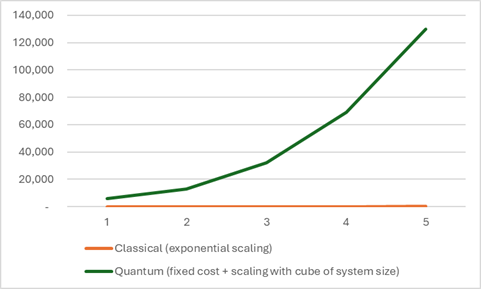
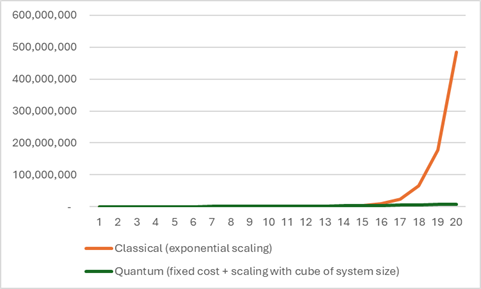
The most promising cases are where quantum computers can provide an “exponential speed-up”. By this we mean that the cost of solving the problem with a conventional computer scales exponentially with problem size, whereas with a quantum computer it scales more slowly, as some polynomial power of the problem size.
Let’s illustrate this with a completely fictitious example, where the cost of the conventional computer solution scales exponentially with the size of problem, but using a quantum computer it has a large fixed cost plus a large factor multiplied by the cube of the system size. The first graph shows that at smaller scales, the quantum computer is much more expensive; however, the second graph shows that maybe even at problems 3-4 times larger, the quantum option can have a huge advantage.
Finding such use cases turns out to be quite difficult. The best example, and most well-known, is Shor’s algorithm, which provides an exponential speed-up for breaking elliptic curve and RSA cryptography. There may also be other exponential speed-up examples, such as modelling the quantum properties of materials.
Going beyond this, into applications like optimising financial portfolios and planning transport schedules, is actually the subject of much academic debate. This is because in practice you need to simplify the problem in some way to make the quantum algorithm work – in which case you must ask if the conventional computer could also solve it more easily with such assumptions.
How do we find the right applications?
Finding the right uses for a quantum computer, that will justify the effort to develop them, will need different communities to work together – business experts bringing the problems worth solving, computer scientists designing quantum algorithms and programs to solve them, and mathematicians who understand the complexity and scaling issues. These are, of course, in addition to the physicists and engineers we need to actually build the quantum computers and get them working properly.
If I’m being honest, right now I think we don’t really know what the “killer app” will be that will justify all the investment being made – but this has been true for many technology advances over the years. After all, no-one guessed in the 1990s that the killer app for mobile phones would be short text messages…
If you remember nothing else…
Quantum computers won’t magically be faster/better/cheaper at doing the calculations today’s computers do. In fact, they will be big, slow and expensive; this is why they will be spectacularly bad at doing most of what we use conventional computers for.
This means we don’t really know what quantum computers will be good for. It turns out that there will be a very narrow set of valuable use cases, where quantum algorithms scale much better than conventional ones. Even then we will need big quantum computers solving big problems to make them worthwhile.
The next few years will be an exciting ride, seeing if we can get to utility-scale quantum computing, and in the meantime we need to keep working on what it will actually be used for.
Other quantum computing articles:
Quantum technology overview – what is it all about?
Explainer – what is quantum computing
Common myths about quantum computers
The biggest (and most dangerous) myth about quantum computers
August 2026 – Tech in Gov Canberra
In August 2026, Rajiv Shah presented on Day 2 of the Tech in Gov expo in Canberra, speaking on “Preparing your systems for quantum computing: what it is and why it will change everything.” The session focused on cutting through…